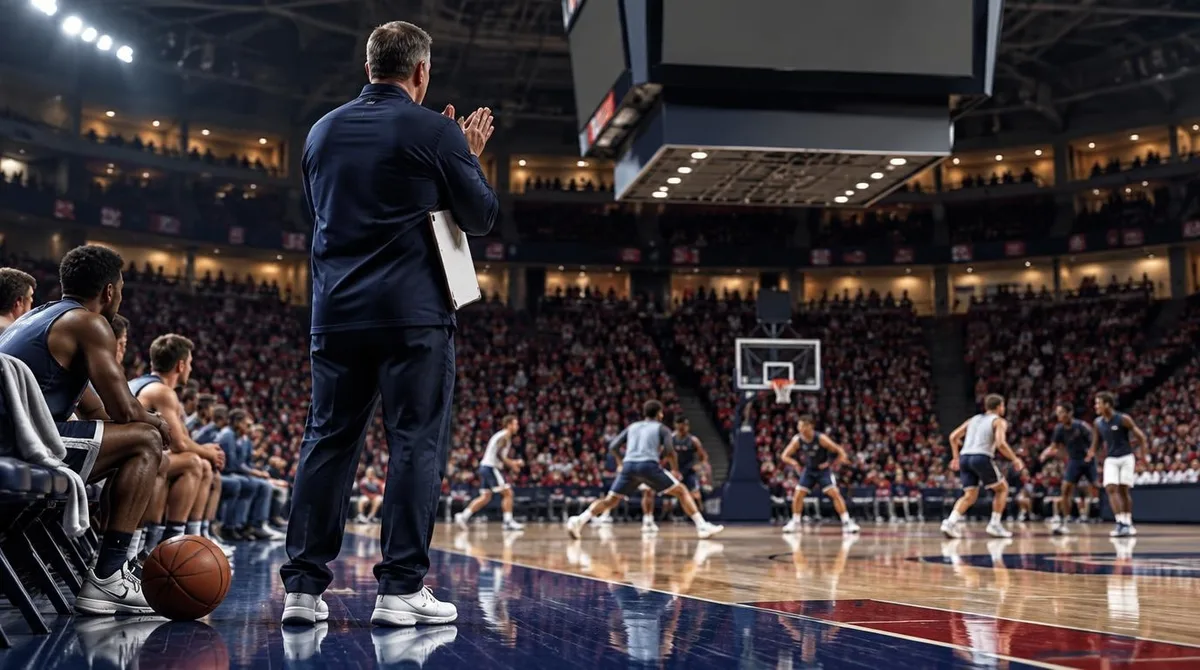
According to Yahoo Sports, Arizona basketball gets a boost ahead of what the report calls a massive matchup with UConn. That is the entire claim the headline makes, and it was published by Bryan Armetta for Heavy on Yahoo Sports on November 18, 2026, at 2:34 AM UTC.
The second question a careful reader should ask is simple: what is the boost? The retrieved text of the report does not say. The visible summary runs three minutes of reading time and carries a photo caption — Tommy Lloyd coaching the Wildcats at McKale Center on January 7, 2026 — but no detail on the substance behind the word "boost." That gap matters, and it is the honest starting point for any second opinion on the story. We covered a connected angle in How an NFL Mock Draft Gets Built: Order, Intel and Guesswork.
This is not a knock on Arizona or on the matchup itself. It is a note on how much weight a headline like this can carry before the reporting underneath fills it in. Readers of basketball coverage see this shape every week in November: a program, a marquee opponent, and a promise that something has improved. The promise is only as good as the specifics that follow it.
What does the report actually establish?
Three things, and only three. First, that a report exists, published on Yahoo Sports under Heavy's byline on November 18, 2026. Second, that its framing treats Arizona's upcoming game against UConn as a major one — "massive" is the report's word, not ours. Third, that Tommy Lloyd is the head coach in position to benefit from whatever the boost turns out to be, per the photo caption dated January 7, 2026, at McKale Center in Tucson. For related coverage, see How the NFL MVP Is Decided: 50 Voters, Five Names, One Trophy.
Everything beyond that — the nature of the boost, whether it involves a player, a return from injury, a roster move, or something else entirely — is not established by the text available here. Stating any of it as fact would be guessing dressed as reporting, and guessing is the one thing a second opinion exists to strip out.
Why do pre-game "boost" headlines earn skepticism?
Because the word is doing a lot of work. A boost can mean a star returning, a recruit landing, a ranking moving, or a shift in how a team matches up. Those outcomes carry very different weight. A lineup change before a marquee nonconference game moves the calculus. A feel-good note does not. Without the detail, the headline asks the reader to supply the significance themselves.
The fair reading, then, is conditional. If the underlying report details a material change to Arizona's rotation or roster, the "boost" framing is justified and the UConn game becomes a sharper test of Lloyd's group. If the detail is softer — a mood, a message, a marginal note — the framing outruns the facts. Both readings are live until the specifics surface.
What should Arizona fans watch for next?
The specifics. When the report's substance is confirmed by a named team or league source — an injury designation, a transaction, an availability update — the story either firms up or fades, and that confirmation is the marker that matters. Until then, the reasonable position is the one this piece takes: the matchup with UConn is real, the report is real, and the boost is, for now, an unfilled promise.
That measured stance is the whole value of a second look. Headlines set expectations; details settle them. For more on how we weigh claims like this one, see our analysis coverage, and for the stories moving fastest across the week, the trending sports desk tracks them as they firm up.